Division With Base 10 blocks: Easy & Fun
Absolutely Amazing Addends is done!
$9.99
Passwords will change again SOON.
***
Base Ten Block CRASH COURSE
Just $97.00
***
Hourly rate is now $60.00 x 5 = $300.00.
$75.00 single classes.
Use the contact link for payments or other communication.
Crewton Ramone's No Mystery Theatre Now Has A Second Page!!!
(More FREE vids!)
And pardon me: for those of you that can't do math, the November 2020 election was stolen. Very basic math. Trump won in a landslide, so did a lot of others...this is why YOU need math.
Algebra with base ten blocks online!
30 Hour Course.
Click for details.
\\\***///
Division is EASY, when you use base ten blocks, you get more information than multiplication or factoring and yet students find it hard and confusing. The way it is taught is what makes it hard and confusing. Most students never even realize that the symbol itself actually MEANS make a rectangle, tell me the other side; the same way they often never get that the symbol for square root means make a square count one side. Long division is universally hated by 6th graders because it is taught 100% rules and process without any conceptual understanding that what we are doing is keeping track of how many times one number is contained in another by subtracting.
Here is an excellent explanation of division concepts, but I think you will find my explanations more consistent and understandable due the superior methodology.
Here are some kids who would be in second grade learning these concepts with problems but because they can see what they are doing with base ten blocks it makes the math easy. Because they have both had several lessons I went backwards starting with a stretch and then getting easier and easier.

Here is some more practice with polynomials; often we start with algebra because it's "generic math". The concepts are THE SAME and many kids note that the algebra is actually easier than base ten mathematics. This starts off with factoring but quickly moves to division concepts which are easy to see Montessorians use the term "visually obvious" which it is when you use base ten blocks.
:
And ends with negative expressions which are slightly off topic for this page.
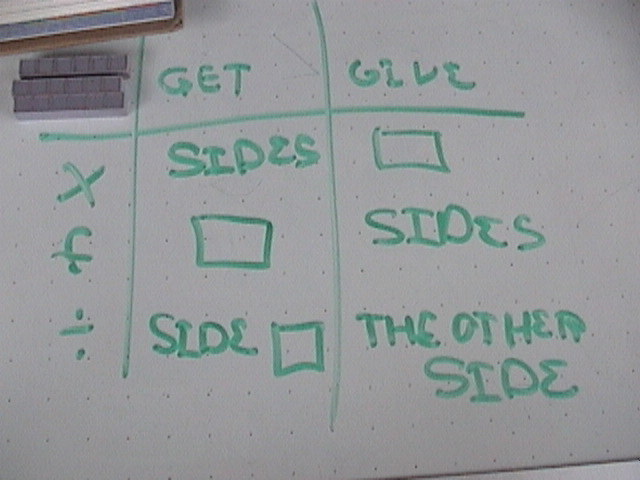
Take a look at this simple chart. It shows what you get and what you have to give when doing these three operations. Multiplication and factoring both involve the sides of a rectangle when you look at it conceptually. Where do you get the most information? When you get the rectangle and one side all you have to give is the other side...so really which one is EASIEST? Then why do we teach it last?
Here is a primer so to speak, covering the three concepts that are intertwined so intrinsically you cannot easily separate them when you are doing concept based teaching, yet text books in public (and private) schools have somehow managed to do so...
Then here is a screencast where I get a little carried away showing exactly how those who used CONCEPT based teaching should NOT do it:
Also beware of using multiplication tables to drill multiplication facts into your students, between the non-clever use of multiplication tables and long division there is often very little love of math left in them by the time they reach those intrepid few who are tasked with the job of teaching them algebra.
There is a short 4 page worksheet for beginner division on the Password Protected PDF's Page. Get a password. They're cheap. Here is a short screencast on how to use said worksheet:
The Module one and three passwords will get you into pages showing percentages, 3rd and 4th power algebra and more, plus more pdf's.
Also buying a password keeps this site up and makes it possible for me to spend the time required to keep putting up new topics and information.
Also be sure to visit the blog, there are lots of videos and entries there that are FREE, that can help you introduce these concepts and make it not only easy but also FUN. Playing with rectangles makes what was "complex" math assessable to students of all ages and skill levels. When they see the pictures the scare factor and hard factor disappear almost magically, although it's NOT magic it's math.
More instruction on best use of base 10 blocks for understanding division concepts:
For more on using base ten manipulatives for division using the Mortensen Method plus a whole lot more have a look at these Series A Manuals online.
Bonus sample lesson:
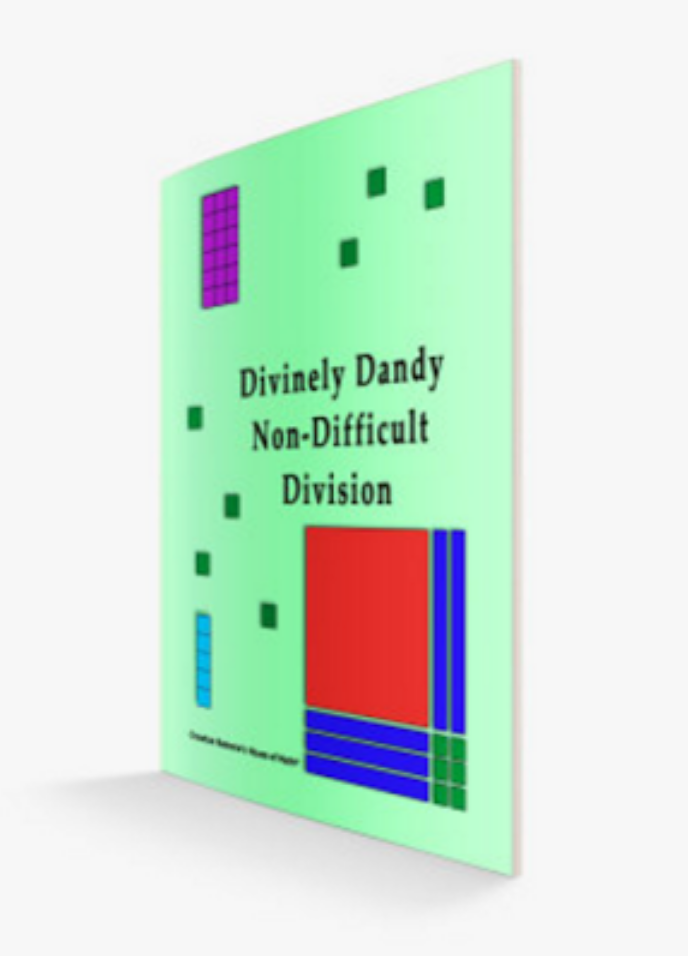
Now, for just $9.99, you can get Divinely Dandy non-Difficult Division, (DDnDD) which will show you how to use your base ten blocks to make division super easy and even fun. The information contained in this PDF can be found nowhere else at any price....
Just send $9.99 to:
Here's a video that tells you little bit more about it:

Go HOME from the Division Page.

More on Division:
Long Division With Base Ten Blocks
Search "Crewton Ramone division" or go to my blog & get Divinely Dandy Non-difficult Division for more. Also check out this link:
Long Division.
"A teacher affects eternity; he can never tell where his influence stops." ~Henry Brooks Adams
"The most important outcome of education is to help students to become independent of formal education." ~Paul E. Gray
"There are two ways to do great mathematics. The first is to be smarter than everybody else. The second way is to be stupider than everybody else -- but persistent." -- Raoul Bott
Crewton Ramone chose door number two.
Want to see more free pages & lessons & other free stuff on this site?
Consider a dollar a month.
For $1 per month (the lowest level subscription) you get access to
The
Super Duper Super Secret Facebook Page.
You'll find hours and hours of videos with base ten blocks and information you won't may not find anywhere else not even on this website. I often post video tutoring sessions there. Other people post vids and links there. Lessons cost the people doing them minimum $50.00 and hour. You can watch 2 to 10 of them a month for a dollar...Do the math. Currently 127 people are there. About half of them are active.
You basically get a support group for a buck a month.
Here's My Patreon:
https://www.patreon.com/CrewtonRamone
Note: from time to time the passwords change. Simply e-mail me for a new one or a new passport as the case may be. Annual passes are good for one year, lifetime passes are good for as long as the site remains up, (site has been up for eight years now). All single page passwords have lifetime renewal.
Note: Mortensen Product Ordering Buttons Have Been Removed Due To Shipping/Inventory Issues. i basically DO NOT sell product for them anymore. Use eBay or other sources for base ten blocks.
Please leave a comment about your experience with division using base 10 blocks.
Want to see more free pages & lessons & other free stuff on this site?
Consider a dollar a month.
For $1 per month (the lowest level subscription) you get access to
The
Super Duper Super Secret Facebook Page.
You'll find hours and hours of videos with base ten blocks and information you won't may not find anywhere else not even on this website. I often post video tutoring sessions there. Other people post vids and links there. Lessons cost the people doing them minimum $50.00 and hour. You can watch 2 to 10 of them a month for a dollar...Do the math. Currently 127 people are there. About half of them are active.
You basically get a support group for a buck a month.
Here's My Patreon:
https://www.patreon.com/CrewtonRamone
Passwords have changed as of July2023.
The superduper supersecret math page on Facebook is NOT FREE. Just sign up for a buck a month or buy a LT password.
**The Crash Course is the same as the 5 Oct 2019 training with a few bells and whistles added like my books and links to free vids you might not find by yourself.
People are shocked and amazed when they see how much they get for a password. $37.50 goes a long way at the house of math.